DESASTRES

DESASTRES

2/10/2014

Are we going crazy?


I can’t hardly understand why people seem to pay no attention when authorities try to make civil protection and warn citizens to follow their advice. This behavior is being repeated once and again this winter in the coast of Spain, where windstorm and heavy rain are causing waves up to 11 meters. A man died swept by a wave last February 28th in Ondarroa (Basque Country)

It is disgrace enough that ordinary citizens do not pay attention to this serious warnings, but what is more worrying to me is that some journalist were already  swept by a wave last February 6th in Donostia (Basque Country) despite the fact that the police were there and they have established a security cordon, whose efficiency you can judged after watching this video.
They were luckier than the citizen from Ondarroa, since they were not in the border of the duck.

A big wawe surpassed the security cordon 
As you can see in the video, two teams of journalists from the news agency EFE  and Antena 3 TV are reached by a wave in the Salamanca Paseo de Donostia while recording images. The camera operator from La Sexta tv was injured after being dragged by a wave in the Cantabrian Sea, as reported the DYA and eyewitnesses.

The victim was recording the maritime storms that hit the Bay of Biscay when a large wave jumped over the jetty and  entered the Paseo de Salamanca , dragging several people.
As a result of this heavy sea, the camera operator suffered blunt force trauma to the lower back and arm, and he ended up in Hospital.


What else do we need?

1/13/2014

Why the emergency should be twitted

This article came to my mind after reading the post Why the emergency will not be twitted. Even though I can accept to a certain extend that data Collection should improve greatly so as to be a reliable channel of information for first responders during an emergency, I am a wholeheartedly advocate of using social media in emergencies. 

Why? Not only because they have proved to save lives (a single life may be worth the effort) but also because social media are here to stay and, as I wrote in some other posts in this blog, social media constitute ways to reach the population in emergencies and to find lost people, as we have seen so recently in Philippines. Therefore, they should be improved to enhanced emergency management, as it is been done since they started till nowadays.


The technology gap


Despite the technology gap, there are ways for people who do not have access to those means, even if internet is still expensive for them. It depends on whether there is a journalist, a humanitarian agency or any one “armed” with a smartphone or a device capable of sharing information using social media in the area. Nevertheless, even if their emergency is not tweeted “live”, there are still reasons to use social media.

If we think of Haiti and the way American Red Cross used social media for fundraising, that is to  me a good reason for using social media in the aftermath of a disaster.


“ In less than 48 hours after launching its first-ever mobile-giving campaign (Text HAITI to 90999), the American Red Cross’s plea for donations was re-Tweeted 2.3 million times. The campaign raised more than $32 million. Forty-two percent of those donors were under age 34”, as explained here

Of course it is still true that Internet not only is not free, neither cheap, and there is a possibility that it will never arrive to all places in the world, but  the advantages highly surpasses the disadvantages. Not to add that internet, when available, is a means to mitigate disaster response, as some communities are doing. Think of Chistchurch, Joplin or the last big catastrophe you have in mind. Sure you will find examples of social media being useful. 

Social media, one more tool in the toolbox

It is true that people rely most on the radio to get information when a disaster strikes, but it is also a fact that people use internet and social media to do so. What is more, if we have a look to the 2012 American Red Cross survey, people expect to be informed and be helped after using social media in case of disaster.


So, social media is one more tool in the toolbox, with its advantages and drawbacks, as any other tool. 
Does anyone think that the radio, tv or traditional media are perfect channels? As a journalist, I like traditional media, especially because I trust the information obtained by realiable and trusted sources and, basically, I can take for granted that information delivered in traditional media is still accurate and truthful. But we all know that communication here flows in one single direction.

We can not hear what the witness and people directly affected by a disaster can add to the story. Neither can we know what they need or where exactly they are, in case they are under debris after an earthquake, as it happened in Turkey in Ocotober 2011.

Resilience

It’s been proved that internet is much more reliable than land and mobile lines, as we have seen during Japan's earthquake and tsunami. Let’s not forget that “Social media was used to perform vital relief functions such as safety identification, displaced-persons locating, damage information provision, support for disabled individuals, volunteer organization, fund-raising, and moral support systems” after the tsunami and earthquake, as explained here, despite the fact that the Japan’s Prime Minister opened its personal Twitter account (@JPN_PMO) on March 16th, when the tsunami struck, and it reached more than 100.000 followers soon after.

Let’s remember that the Japan’s Government didn’t have a Twitter account in those days and opened it immediately.  Not to mention what a great effort they did with Google Person Finder.

The human contact

We all could agree to the fact that human contact is fundamental in a disasters situation and, as human beings we all can feel comforted by a hand on our shoulder assuring that everything will be all right after a disaster strikes. Contact eye, a supporting hand and the warm of human company is important, no need to insist on this.

Nevertheless, what it is most important to anyone in a disaster situation are two things: getting the right means (including information) to survive and to know that our loved ones are Ok, as well as letting them know that we are safe. Both means can and are achieved through social media, as people expect, according to the American Red Cross survey mentioned above. Facebook is a clear example, as I explained here, and you can see also here.

Bird covered in petrol after Gulf's oil spill 2010 ( www.huffingtonpost.com)


Psychological impact

Another issue that  is the use of grief made by traditional media, who” will often show repeated negative images: People who are dying or in distress, lacking food and water,  animals that have been abandoned, hurt, or covered in oil ,Lndscapes, such as collapsed buildings, flooded homes, or oil floating on top of water”, as explained in chapter II of  this document .

Social media are horizontal, if we need help we can ask for them directly, expressing plainly what we need (food, shelter, information) with no need to victimize ourselves or others, as well as giving information that may be helpful to first responders and humanitarian agencies.

To sum up, social media had become an integral part of disaster response whose importance, for many reasons, is undeniable to me.

If you are still not convinced, you may have a look to this article about a baby being rescued in Australia with the help of Twitter Alerts.

What do you think?


12/15/2013

Alert4All, a step towards a pan European effective alert communications' system


Europe is a reality made of 27 countries and a common emergency number (112), where you can communicate any emergency situation everywhere within the European territory, despite the fact that 23 different official languages are spoken. Each country has its own emergency system and, up to day, there isn’t an harmonised approach to alert the population in Europe.

“The Alert4All goal is to improve the effectiveness of public alert and communication during crisis situations in European member States. This implies that Alert4All intends to reduce the impact of disasters (in terms of losses to health and life, as well as economic impact), by informing efficiently and on time the population at risk”, explains Cristina Párraga, Alert4All project manager.

“On the one side, this means that Alert4All is directed to the civil protection officials that shall inform the population, but also, and more importantly, to the European citizens that shall benefit ultimately from improvements in public alert systems”, adds Párraga.

You can also watch an interview in Spnish with Cristina Párraga here.


Relevant improvements in public alert using different technologies

Alert4All “improves communication features, cooperation between authorities and situation awareness. On the communication features’ side, Alert4All allows disseminating alert messages over many communication technologies directly to the citizens own devices, such as digital and smart TV, mobile phone and navigation device, but also over in-building security systems, such as the LED screens in railway stations, voice evacuation systems in malls, or schools and mass notification systems, such as public screens.


 Messages are received in the recipients’ selected language

The recipients’ will received the alerting message in their own language and in text or speech and in a harmonised way, “so that the alert message would look the same way regardless from the official, civil protection office or country from which the alert message is issued. This shall improve the familiarity of citizens with the public alert system and their trust on and understanding of the message.”


Alert4all fosters cooperation among several protection agencies

 “Alert4All provides means for rapid and efficient information exchange when several civil protection agencies are involved in the same crisis situation, which in turn improves coordination and cooperation”, explains Párraga.

Based on Social Media to improve the decision making process

“Alert4All has developed a screening of new media tool that observes how the population understand the situation and, based on this knowledge, to improve the decision making process. The impact that the crisis situation has on the population is inferred from the information that people generates on social media (Twitter, Facebook, Flickr, YouTube and collaborative web sites).”


Sentiment analysis to enhance situational awareness  

“The information is analyzed to extract that are presented to the civil protection officials as sentiment trends over time, namely how people feel about the crisis and the communicated alert messages. This implements and indirect feedback channel in public alert communications, which have been unidirectional up to now. “

Estimating the message’s impact

It is also possible estimating  “if alert messages have been transmitted to, understood and believed by the relevant people and not only to technical devices, taking into account not only technical aspects but also social behaviour of the individuals and crowds“ using an alert impact simulation tool.

“This alerting effect simulation is considered by the involved crisis managers to be very useful both in preparedness planning and for investment decisions about additional channels for public alert purposes.”


Welcome to this new platform, as an important step needed to unify the emergency system in Europe. Don’t you find it necessary?

11/14/2013

Santiago derailment’s train. Which code of ethics?


“Ethical codes are adopted by organizations to assist members in understanding the difference between 'right' and 'wrong' and in applying that understanding to their decisions. An ethical code generally implies documents at three levels: codes of business ethics, codes of conduct for employees, and codes of professional practice”, according to a definition found in Wikipedia, to which I basically agree. 

This post is about the resolution expressed by the Press Associations’ Federation of Spain (FAPE) related to the images uploaded to Twitter last July 24th  2013, when a passengers’ train derailed in Santiago de Compostela, causing a big catastrophe, as I explained here.

Today the Press Manager of Madrid 112, @LuisSerranoR published a post in his blog showing his total disbelief with the sentence that explains why there is no ethical issue regarding the picture of a little girl being rescued by a firefighter that day. In that picture it is perfectly visible the child’s face, with no respect to her basic right to intimacy, since she is a minor and a victim. Let me add, now a double victim.

As @LuisSerranoR says, we are used to see the pictures of all the celebrities’ children with a veil on their faces, so we don’t know how that child looks like. It sounds at least weird that an organism that should be an example of best practices for the journalist tells us that there is no problem here because the protagonist of the image is not the child but the firefighter.Besides, they add, her family didn’t complain. What a lucky circumstance! Can you imagine thousands of victims all around the world complaining because of that?

What is more, if she is not the protagonist, but the firefighter, Why don’t you remove her, or at least cover her face?

No comments on that.

The ethical committee also explains that the picture “reflects the reality”. So what? 

It also adds that “journalist's commitment to truth can not fail.” Really? To begin with, reality, as @LuisSerranoR says, is something not that clear and, even if it was, we can not skip children’s rights arguing that. As the above definition says, it is an obligation of an organism that represents the journalist be clear on  what is right and what is wrong.

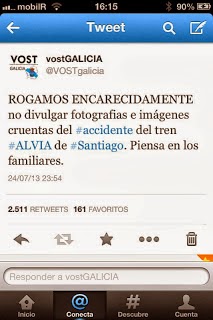
Tweet asking not so share unappropriate victims' pictures

Tweet asking not so share unappropriate victims' pictures 
Luckily, most of us know. That’s why emergency managers, VOST members and teams, journalists and some other people did our best that day to avoid that sort of images being shared through social media.
         
The sentence also says that the picture is “essentially objective and truthful”. Again, What is objectivity? Even more. I don’t care. I have two children. If that child were my daughter I would feel terrible. Anyone would. Is that so difficult to understand for a commission that should take ethical issues into consideration? Psychologists have already  given their professional opinion on the topic.

The picture shows the impact of the catastrophe?

I have no words. Simply. Al least 79 people died and 178 were injured. Do we need a picture showing a girl to realize the impact of the tragedy?

“The presence of the victims brings solidarity and serenity ", reads the sentence. Again. We are talking of fundamental rights according to our 1978 Constitution (art 18): honor, privacy, image
.
The last straw. “Pain and distress is the result of the accident victims”. Thanks God. So we can go to bed with peace of mind. It is not the journalist' fault. Can anyone seriously affirm so? Come on… Of course! If the train had not derailed there would not have been any pain!

To our disgrace, we see almost daily these sorts of pictures both in traditional mass media as well as in social media. But, up to day, never ever has an organism supposed to care for the ethical journalism’ issues affirm that sharing thesesort of pictures is all right.


If they are right, I must be terribly wrong, and I won’t follow their advice. I’d rather be and independent professional with my own ethical code. What would you do?

11/13/2013

#RescuePH, Social Media to rescue in Philippines

Social Media are proving, one more time, to be an effective and on time channel to coordinate the rescue efforts when a disaster strikes. After typhoon Haiyan hit the Philippines, citizens are using the hashtag #RescuePH in Twitter, the RescuePH Facebook page, the Google finder person and also the crowdmap that allow people to send a text message to locate people who need help, among other resources.

RescuePH, started in 2012, encourages Filipino netizens to tweet out calls for help. Users can fill out a form on the project's site, which populates an interactive map of people in need. 


Since #RescuePH has been used massively, Twitter Philippines has requested not to use the hashtag unless you need help.


It is also possible to send a text message asking for help


To use the Google person finder


And to upload a picture to Twitter with the image of a missing person you are seeking.


How to cooperate

To cooperate with the Standby Volunteer Task Force (SBTF) to help the Digital Humantarian Network (DHN) tagging tweets in response to Typhoon Haiyan, is also a possibility, as Patrick Meier explains here, here, and here.


Philippine Red Cross has also facilitate means to donate sending a the text message using its twitter profile @Philredcross

So once more, social media is providing an effective channel to help in a disaster. Do you have any other examples to add?

10/21/2013

#Edcivemerg, a dream coming true

A year and a half ago, a group of professional related to the emergency field joined our efforts to ask for a wish long time wanted: teaching all the children in Spain First Aid, Civil Protection and contents related to Emergencies, within one or more compulsory subjects, so we can ensure that all children will be capable not only to protect themselves but also to act as first responders while they wait for the emergency services to arrive. Today, the Senate approved a Parliamentary bill in this sense, and we all hope that it will be a reality in schools as soon as possible.


It’s been a long way since February 1st, 2012 when a group of people joined our efforts in #Edcivemerg to make this dream a reality, spreading the word that our children today can save lives tomorrow, as I already explained here, and today it is a benchmark marking the starting point.

Edcivemerg members in front of the Senate

Besides expressing my happiness and emotion, I wish to say thank you, first of all to all my colleagues who have been working without dismay, but also to the media, the professionals who have given their support in social media, as well as the scientific and proffesional societies and the politicians who backed up the initiative all around the country. 


We had a dream, and today it has come true!

8/04/2013

Crisis communications in Santiago's derailment accident

More than a  week has gone since a passengers' train derailed in Santiago de Compostela (North Spain), causing at least 79 death people and more than 100 injured. Despite the fact that Galicia 112 Twitter account was not operating and @Xunta shared  its first message 50 minutes after the derailment, social media proved an effective way to inform about the incident and, what is more, VOST teams as well as local influencers  were capable of countering criticisms, helped spreading the right information and cooperated intensely to stop a bad habit in Twitter: uploading  pictures where injured or dead people are shown  with no respect to the victims’ intimacy. Citizens also used Twitter to ask for help to find their loved ones, sharing pictures with birthmarks, tattoos or some other physical description to facilitate the task and asking for a RT.

@VOSTSpain beware their followers not to rumors into consideration

Let’s try to analyze how authorities used social media here, what they did well and what improvements could have been possible.

First of all, it is a pity that the official account @112Galicia is still not working. The account is set in Twitter. It has 104 followers but, for the time being, it has not been used, despite the fact that there are very good and qualified journalists working in Galicia 112 capable of managing it. The local authorities may know why they lost this chance to inform citizens directly using an official and credible source.

@Xunta, almost an hour to inform

@Xunta, the official account of the local Government, did try their best to cope with the situation. Before going on, I’d like to point out that they are not specialist  in crisis communications. The information delivered was accurate and useful, but it was a bit too slow. The train derailment happened at 20.41 on Wednesday 24th. @Xunta wrote its first tweet at 22.24. 50 minutes late and only to say that they would offer official information soon.


It took then 20 more minutes to say blood was needed (22.44). In the meantime, people were sending messages about this issue and it was really a bit difficult to be certain whether it was best to go to hospital to donate blood or to stay home and leave the roads free for emergency services because messages saying one thing and the opposite were simultaneous.

The donating blood issue was to me, a fail, saved, partially, thanks to the National Police account @policia , who put a bit or order here.


Using hashtags to follow the conversation

@Xunta, the official account with more than 27.000 followers didn’t create a hashtag to follow neither they use any to facilitate following the conversation. If you wanted to know what they were saying in Twitter the best way was to add a column in Hootsuite or TweetDeck. The problem to me was simple: lack of expertise, besides the obvious fact that they were overwhelmed by the tragedy.


Despite the delay and the confusion, @Xunta provided useful information helped by VOST teams, like @VOSTGalicia, @VOSTSpain, many influencers using their personal profiles and @112cmadrid, the official account of 112 in Madrid. The later seemed to turned into the official 112 voice in the absence of @112Galicia and, probably, due to the insufficiente response's capacity of @Xunta.

Up to 3 different phone numbers to search information

The information phone numbers issue was as well a failure. I founded at least 3 different
(I’ve been told that there were up to 5).


Nonetheless, I  don’t like to finish this article without pointing out that @Xunta did their best and that, despite all possible improvements, they managed the situation quite well considering, as I already said, that it is not their duty to handle crisis communication.


I also want to remark that I am very proud of how voluntary services as well as ordinary citizens reacted to this tragedy, offering all the help they could, in the derailment's scenario, and using social media.

José Sieyro, President of Caldas Civil Protection having a rest
on the railway after working all night