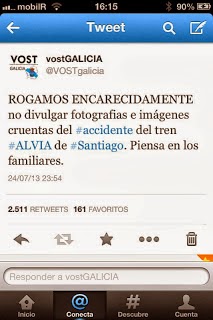
Disasters and
journalism in the digital age was the topic of the XVII Journalism
Laboratory hosted by The Press Association in Madrid on May 7. I was inviting
as iRescate director and as @vostSPAIN spokesperson to debate with my
colleagues on the issue where some conclusions where reached. You may listen the whole lab here (in Spanish)
@LuisSerranoR,
director of the Communication Crisis de Llorente y Cuenca, estimated that the communicatinons' scenario "has radically changed" and "Twitter
has become the backbone os mass media". "Social networking will democratize the
conversation," he said.
I spoke of the whole
new landscape we face with social media since communication is not anymore a one
way process and since the so called citizen journalism is making us dealing
with rumors, also emerging for the lack of reliable sources of information. It
was also my concern the double victimization of those whose faces were broadcast
once and again, especially in the case of women of children, since their
exposure prevents gender’s equality.

Alipio Gutiérrez, Nemesio Rodríguez, María Luisa Moreo y
Pablo Herráiz.
Foto: Elena Hidalgo / APM
Alipio Gutiérrez, President
of the National Association of Health (ANIS), said that social media are a "huge
opportunity, but also a great danger." Therefore, he asked journalists to
report with "their most ethical commitment and responsibility." He
also urged the authorities to require transparency when conveying information;
otherwise, "you are doing a disservice to democracy".
Paul Herráiz, crime reporter
from El Mundo point out the need of "not rushing to make a
scoops on Twitter or Vine since one thing is the need to deliver information
immediately and a different one to write a piece of news in a hurry, whose
consequences are usually a mistake. "
Javier Barroso, crime
reporter for El País, pointed out how much journalism has changed
since we have social media. “Before (social media appeared, you worked, to some
extent, with tranquility; today, information is delivered with two or three
paragraphs to check out urgent search engine ". In the "maelstrom of
immediacy," he urged caution and not to publish news before the official
sources confirmed.
Carlos FernandezGuerra, journalist and community manager of the National Police,
emphasized the importance of knowing how to distinguish the reliable sources of
information. He also emphasized social
media as an information tool to helps authorities. Finally, he warned of the
need to focus on the victims when talking of a disaster.

F Javier Barroso, Carlos Fernández Guerra y Luis Serrano.
Photo: Elena Hidalgo / APM
From the conclusions
drawn in this Laboratory of Journalism, which was moderated by Nemesio
Rodriguez, deputy secretary and spokesperson for the APM, the following recommendations
were developed to report on tragedies such as the recent rail accident in
Santiago de Compostela, the Ebola crisis, the attacks of "Charlie
Hebdo", the Germanwings aircraft crash and the Nepal earthquake.
You also have a
Storify here (in Spanish)
Decalogue Madrid’s Press Association on disaster and
journalism in the digital age.
1.- It's essential to
focus attention to the traditional rules of journalism, due to the new
communication scenario produced by the introduction of social networks and new
technologies.
2.-Mistakes and hoax
comes from the lack of verification, rigor and precision, despite the
requirements of immediacy (related basically to Twitter). Contrasting the
sources of information is an essential requirement. Before the overloading of
information, it is a must to distinguish a reliable source.
3.- The Prudence
should underlie before the rush inherent to digital media for reporting immediately.
The rumor and speculation in disasters should not become news until confirmed
by official sources
4 .- The Journalists
should exercise extreme ethical commitment to reliably distinguish what to say,
when and how. We are responsible for what we say.
5.-The Journalists
must respect the pain and privacy of the victims and their families. We only
should contact them under their previous assent. We should show our empathy
when interviewing them and informing the public about them. We must always bear
in mind that victims are the most affected.
6.- Striking images
are suitable only in the case they provide an added value to the information.
It is not acceptable to repeatedly broadcast victims' images, taken into
account that after these images there is human beings’ suffering.
7.- The gender issue
should be taken into consideration when seeking for victims’ images to
illustrate news. Women and children usually appear as victims, while men take a
different role in the aftermath of a disaster. This emphasizes the cliché of
feminine weakness and does no contribute to gender equality.
8.-In case of
terrorist attack, the journalists should exercise extreme caution and think
twice whether to publish sensitive information on social networks.
9.-They journalist
should keep in mind that this information can be valuable to terrorists. The
journalist should also avoid turning the terrorist into the protagonist of the
event, since there are victims suffering from their terrorist action.
10.- Coordination
between PIOs and the press is essential to avoid and clear hoaxes in social
media
11.- The authorities
should be demanded maximum transparency when giving information related to
disastera, since the absence of trusted and updated information foster the use
of non-trusted information´ sources.
12.-The official
Press offices must lead the information process in order to deal with the
uncertainty of the lack of informationabout the tragedy.
13.-the Media must
report "invisible tragedies", for example, diseases virtually unknown
until they become an epidemic.
14- There is a need
for a greater self-criticism among journalists. Although websites mistakes can
be corrected, they are likely to harm any citizen during the time they are
published.
15.-The Journalists
covering tragedies and disasters can suffer emotional "shocks" or
traumas. Therefore, it is necessary that these professional may receive
psychological help in situ and in the aftermath of a disaster, as some other
professional do.
All this said, do we
need an ethic’s code? What do you think?