DESASTRES

DESASTRES
Mostrando entradas con la etiqueta VOST. Mostrar todas las entradas

6/24/2015

VOST emergency drill reaches 268,735 in TATGranada15


A big industrial fire was the scenario where @LuisSerranoR, the dircom of Llorente y Cuenca, set up an emergency drill with the cooperation of @vostSPAIN, including president @Galvez Rivas, spokesperson (myself), @VOSTEuskadi Jokin Zubieta and @VOSTCanarias @JaviBlancoF presidents, as well as other team members and emergency communications specialists.

The drill started during Luis Serrano speech about crisis commons when he announced that a live exercise would be held using Twitter. It started when @GalvezRivas tweeted  that a big fire has just started in a  solvents factory and 15 fire crews plus 5 ambulances were in its way to the place, even though there was no one hurt.


After the first tweet, seven more Twitter fake profiles worked for about 20 minutes to show how emergency services, VOST team and mass media (a radio station under the name @OndaCerosimulac) deal with an emergency in the social network and do their best to inform the citizens and to stop rumor spreading through the web. 

I was in charge of the mass media profile, @OndaceroSimulac, working from my office in Madrid, while my colleagues where attending the event live in Granada (South of Spain). All of us worked coordinated following the Timeline using the hashtag #SimulacroTAT  and uploading information and pictures as we usually do when there is a real disaster here in Spain. 

We also were counting on two profiles spreading rumors (@Trollsimulacro - @josetes112- and @enteradillosimu - @ffdezalcaide). Besides, we also had a person who was asking for his father, @familiarsimul - @Ant_Varon- whom she has not seen and who finally died due to the incident. 


@112simulacro (112 is the official emeergency number in Europe)  and @industriasimul (@JaviBlancoF, from VOST Canarias) led the communications process from the beginning, updating emergency numbers, facts and figures related to the emergency. So did VOST, who also included a picture with the hazardous substances forming a toxic cloud. The mass media radio station retweed the official sources (@112simulacro and @vostsimul) and asked all the rest updated information


@Brigadistasimul (@gemaimorcillo)   and @enteradillosimu (@ffdezalcaide) played two controversial roles. The first being a fireman tweeting inconvenient pictures and confronting the emergency service and the second acting as a person who seeks notoriety trying to be a source of information.  


The troll @Trollsimulacro  (@josetes112) as expected, cursed all the time and everyone. Obviously, no one talked to him.


The drill’s impact

If we have a look to Tweet Binder, the drill had  268,735 Potential impacts, 130,358 Potential reach, 85 Contributors,  1,534 Followers per contributor and 2.45 Tweets per contributor.


The activity peak was as 1.05 pm on June 23rd.


It was my pleasure to participate in the exercise and I feel proud to be a member of VOST, since they play a fundamental role, when a disaster strikes. I also find it very important to practice using a simulated scenario, so we will be ready in case the black swan appears. 

Don’t you agree?

10/06/2014

MIT Laboratory for Social Machines, a bet to avoid a mayor emergency in Twitter


The MIT Media Lab announced the creation of the Laboratory for Social Machines (LSM), whose main goal would be the creation of programs aimed to develop collaborative technologies to tackle complex social problems, as you can read here. This would be great news for the emergency management world as long as Twitter itself developes new technologies  capable of detecting a big streaming growing up in Twitter. Once we have this problem solve, it would turn into the best tool for PIOs to control rumors when a disaster strikes. If we admit that Twitter is the biggest web of reporters existing ever (with all their drawbacks) and that it offers a synchronized experience, as @dkroy explained in #TATGranada2014, there is an urgent need to put an order in this huge stream of information. We’ll try to explain in this post (co written with @LuisSerranoR) why and how this new tool may help.

It is true that there are some ways to monitor conversation in social media (we are talking about Twitter basically here) when a disaster strikes. We can add a column either in Hoosuite or Tweecked with a Hashtag (ie: #Sandy, #yycflood) and this helps to monitor the conversation. I always tell my students that a tweet without a Hashtag is like going to a Big Store without a directory indicating you where the goods are. If you want to buy shoes you go to the shoe section- not to the bakery. So if you want to follow the news of a Hurricane your follow the HT with its name.


We could also follow the official source of information (usually the Government, local authority, and so on) or a list of influencers and people we trust as a reliable source of information, but still, we cannot stop rumors because we lack relevant information: where and when (the exact time) the tweet was posted being the more important. Moreover, we need to detect the rumor going viral from the very beginning.

Time is relevant to stop rumors going viral

The thing is we don’t have any app capable of detecting a huge stream of (false- not trusted) information expanding at an incredible speed. By the time we detect a rumor in social media, it would have been retweed thousands of times; it would have become viral and would have caused undesirable effects. We would be lucky if we can still control the situation if a big disaster strikes, considering the speed of Twitter. Just remember the 6.000 tweet per second in the aftermath of Japan’s earthquake .That's why Twitter would the one to offer the Technological solution.


Using a HT helps, but it is no enough to stop rumors

What I describe above is a way to follow only the information of a topic and spare the rest. But, as explained, besides detecting the rumor stream there are some other issues to solve: where and when a tweet was posted (most tweets are not geolocated); whether the information delivered is updated, relevant, and trustful and who is the source of information (when this is not indicated). Our main problem remains. We need a lot of hands (VOST teams) to stop rumor spreading through social media.


As @LuisSerranoL says, one day we will face a mayor disaster amd rumors will be so big that we will not be capable of controlling them. Unless we find a way to really scrutinize social media and get the information delivered in a manner we can decide what is worth and what is rubbish at the speed needed to stop a mayor disaster. 

500 million tweets per day and 241 million users deserve a solution to the Twitter conundrum, especially when we are talking of saving their lives, properties and the enviorenment. It is on Twitter's hands to provide a tool that helps emergency managers making civil protection to save  lives using social media.

If Twitter succeeds in creating this rumor detector, the microblogging site would move from being just a mass media to effectively save lives in emergencies. This step would be the base above which  Public Administration and VOST teams all over the world would build a holistic strategy to stop rumors.

As @dkroy heard  at #TATGranada14 from @LuisSerranoR speech: “100 firefighters cannot stop a tsunami without the help of they who control the web”. The Laboratory for Social Machines is undoubtedly a huge step to fulfill this goal.

7/23/2014

Can we avoid Tweets expiring in emergencies?


Yesterday night I was reading @LuisSerranoR post explaining why and how tweets expire in emergencies and whether it would be possible to find a solution. I completely agree with him in his approach. Nonetheless, I’d like to add one more step in the possible solution. That is: if only Twitter can make it possible to counter criticism efficiently, let’s ask them to make an app to solve the problem.

As @LuisSerranoR explains so well, we have a problem (in emergencies) when people collapse the timeline with old information regarding, for instance, the need for blood donation. If that happens, roads might be collapsed and hospital overwhelmed, so they won’t be capable of attending injured patients who really need their help.

Detecting rumors in Twitter

The first step to detecting that something is going on (whether they are good/bad news or rumors) is a peak in the number of messages coming for a source or being retweeted. Let’s offer an example. I realized that King Juan Carlos of Spain resigned the throne because my iPhone screen informed me that several of my contacts had retweeted @CasaReal. So I had a look and discovered the big scoop going on.  Since the source was official and verified, the information was correct.


What happens when we follow non official accounts and make RT without checking the time when the info was pushed?

As I already said, old information spreads, with the consequences already known.

Why do we spread that info without checking? There are many reasons. Being lack of expertise the first and most obvious of all, good will is another. We want to be helpful, so if we read in Twitter that blood donation is needed most people would retweet straight away, without thinking whether blood was needed some hours ago, but it is not anymore, as @LuisSerranoR says.

The added problem is that people are not as fast as they were before when it is time to retweet that blood is no needed any more. That’s because the previous action make us feel better people, while the second does not seem to be as important issue as the previous one.

The same would apply to pictures. We only have to see what happens with false pictures during Sandy Hurricane.


VOST teams are not enough

Neither VOST teams nor influencers are capable, by themselves, to stop this tsunami of information; no matter how hard we work or how many we are (we are quite a few here in Spain).

If we agree that the emergency should be twitted,  only Twitter, detecting in due time the peak of information, would be capable of stopping this process by making a tool (an app?) which analyzes this phenomenon and acts as a content curator.

Let’s hope it will be develop before a really huge catastrophe strikes.


Any thoughts?

6/17/2014

Want to handle crisis communications? Use Social Media and VOST


Summer is here and forest fires have already started in Spain. It is a season when rumors spread through social media even more than during the rest of the years due to the lack of news. If during an accident like the Santiago's derailmenttrain (or any crisis of this magnitude) is important to monitor and control social media, we cannot afford putting at risk citizens now that we have ever more population because of the holiday season. 

So, If you are the authority, you’d better follow some advice:

Create the HT and push informacion as soon as possible

It is the best way to monitor and control rumors from the beginning. If you lead the crisis communications process pushing information from the very beginning of the crisis with a hashtag, it will be much easier to follow the conversation and avoid rumors.

If you have not been fast enough and citizens are using other HT use it. In case of forest fire there is a convention here in Spain, so it is simple. We use #IF (meaning forest fire), plus the name of the locality. #IIFF if you are talking about forest fires in general (how to prevent, advice, and so on).


Monitor social media

Monitoring social has never been that simple by using apps, like Hoosuite, Tweetdeck and many others. We are plenty of tools and it is quite sensible to use some of them to save time and organize information, so we know what it is being said about the crisis.

Don’t forget traditional media

Social Media are just one more tool in the toolbox. It is extremely important countering criticism here because of their virality. But traditional media can help us with stopping false information if we ask them to do so. The civil protection chain includes TV, radio, on line newspapers, communication agencies and any other means to transmit the right information so long as the citizens follow them.

Use Whatsapp, direct messages in Twitter, or a traditional phone call to contact them.

Work with VOST teams

The VOST teams are also an essential part of the civil protection chain nowadays. There is no one single Emergency Communications Centre in the world capable of controlling social media if a really big catastrophe strikes, neither in Spain nor anywhere in the world.
So, count on them. VOST teams in Spain work wonderfully. We have the “Dad” account @vostSPAIN plus one account for every territory (17) and 2 more for Ceuta and Melilla.


They formed a very well-coordinated team. Working together with influential people we are fast enough (from the time being) to stop rumor spreading through the web. A WhatsApp group containing influential will be of great help, as it is here is Spain.

Don’t talk to trolls, unless it is necessary

A troll is a person who usually insults your and wants your attention because of notoriety. If you answer them you will act as an amplifier. If the troll is putting neither lives nor properties in danger ignore them. Moreover it they are people with practically no followers and no one pays attention to what they say. Don’t give them a thought, if they don’t interfere with the command and control operation to solve the crisis.


11/14/2013

Santiago derailment’s train. Which code of ethics?


“Ethical codes are adopted by organizations to assist members in understanding the difference between 'right' and 'wrong' and in applying that understanding to their decisions. An ethical code generally implies documents at three levels: codes of business ethics, codes of conduct for employees, and codes of professional practice”, according to a definition found in Wikipedia, to which I basically agree. 

This post is about the resolution expressed by the Press Associations’ Federation of Spain (FAPE) related to the images uploaded to Twitter last July 24th  2013, when a passengers’ train derailed in Santiago de Compostela, causing a big catastrophe, as I explained here.

Today the Press Manager of Madrid 112, @LuisSerranoR published a post in his blog showing his total disbelief with the sentence that explains why there is no ethical issue regarding the picture of a little girl being rescued by a firefighter that day. In that picture it is perfectly visible the child’s face, with no respect to her basic right to intimacy, since she is a minor and a victim. Let me add, now a double victim.

As @LuisSerranoR says, we are used to see the pictures of all the celebrities’ children with a veil on their faces, so we don’t know how that child looks like. It sounds at least weird that an organism that should be an example of best practices for the journalist tells us that there is no problem here because the protagonist of the image is not the child but the firefighter.Besides, they add, her family didn’t complain. What a lucky circumstance! Can you imagine thousands of victims all around the world complaining because of that?

What is more, if she is not the protagonist, but the firefighter, Why don’t you remove her, or at least cover her face?

No comments on that.

The ethical committee also explains that the picture “reflects the reality”. So what? 

It also adds that “journalist's commitment to truth can not fail.” Really? To begin with, reality, as @LuisSerranoR says, is something not that clear and, even if it was, we can not skip children’s rights arguing that. As the above definition says, it is an obligation of an organism that represents the journalist be clear on  what is right and what is wrong.

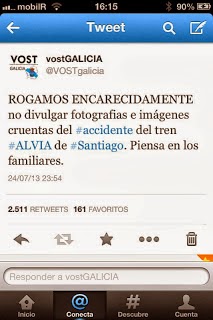
Tweet asking not so share unappropriate victims' pictures

Tweet asking not so share unappropriate victims' pictures 
Luckily, most of us know. That’s why emergency managers, VOST members and teams, journalists and some other people did our best that day to avoid that sort of images being shared through social media.
         
The sentence also says that the picture is “essentially objective and truthful”. Again, What is objectivity? Even more. I don’t care. I have two children. If that child were my daughter I would feel terrible. Anyone would. Is that so difficult to understand for a commission that should take ethical issues into consideration? Psychologists have already  given their professional opinion on the topic.

The picture shows the impact of the catastrophe?

I have no words. Simply. Al least 79 people died and 178 were injured. Do we need a picture showing a girl to realize the impact of the tragedy?

“The presence of the victims brings solidarity and serenity ", reads the sentence. Again. We are talking of fundamental rights according to our 1978 Constitution (art 18): honor, privacy, image
.
The last straw. “Pain and distress is the result of the accident victims”. Thanks God. So we can go to bed with peace of mind. It is not the journalist' fault. Can anyone seriously affirm so? Come on… Of course! If the train had not derailed there would not have been any pain!

To our disgrace, we see almost daily these sorts of pictures both in traditional mass media as well as in social media. But, up to day, never ever has an organism supposed to care for the ethical journalism’ issues affirm that sharing thesesort of pictures is all right.


If they are right, I must be terribly wrong, and I won’t follow their advice. I’d rather be and independent professional with my own ethical code. What would you do?